
Views: 28 Author: Site Editor Publish Time: 2026-01-13 Origin: Site


In the modern industrial landscape, AC motors serve as the "power backbone" driving countless production processes—from the fans circulating air in factories to the precision tools shaping components on assembly lines. Their significance extends beyond mere functionality: motors account for over 60% of global industrial electricity consumption, making their efficiency and performance critical factors for both operational costs and environmental sustainability.
As industries embrace green transformation and intelligent manufacturing, the demand for AC motors has shifted from "basic operation" to "high efficiency, reliability, and scenario adaptability." This article explores the core principles of AC motor efficiency and performance, analyzes their practical applications in industrial contexts, and introduces tailored solutions that balance energy savings and operational needs.
Motor efficiency refers to the ratio of mechanical output power to electrical input power, reflecting how effectively the motor converts electricity into usable work. Inefficient motors waste energy as heat, increasing both energy bills and maintenance requirements.
The International Electrotechnical Commission (IEC) has established global efficiency standards (IE1 to IE5) to categorize motor performance:
• IE1 (Standard Efficiency): The basic level, now gradually phased out in industrial applications due to high energy loss.
• IE2 (High Efficiency): Offers moderate energy savings, often used in light-load or intermittent operation scenarios.
• IE3 (Premium Efficiency): Became the mandatory minimum standard in many countries, balancing cost and energy performance.
• IE4 (Super Premium Efficiency): Delivers significant energy reduction, suitable for continuous-operation equipment like pumps and compressors.
• IE5 (Ultra Premium Efficiency): Represents the current peak of efficiency technology, ideal for long-term, high-load industrial processes.
A simple analogy helps illustrate efficiency impact: A 100kW motor operating 8,000 hours annually at 6,000 per year if upgraded from IE3 (94% efficiency) to IE5 (96.5% efficiency). Over a 10-year lifespan, this totals $60,000 in energy cost savings—far exceeding the initial investment in a high-efficiency motor.
Beyond efficiency, several metrics define an AC motor’s industrial suitability:
• Torque: The rotational force driving machinery, critical for starting heavy loads (e.g., conveyor belts in mining).
• Speed Stability: The ability to maintain consistent rotational speed under varying loads, essential for precision manufacturing (e.g., CNC machines).
• Reliability: Resistance to harsh industrial conditions (high temperature, dust, vibration) and long service life with minimal maintenance.
• Response Speed: How quickly the motor adjusts to speed or load changes, vital for automated production lines.
These metrics are interdependent—for example, a motor with high torque may consume more energy if not optimized for efficiency, while an ultra-efficient motor may fail in heavy-load scenarios if torque is insufficient.
Different industrial sectors have distinct requirements for AC motors, as summarized in the table below:
Industrial Sector | Core Equipment | Efficiency Requirement | Key Performance Focus |
General Manufacturing | Conveyors, pumps, fans | IE3+ | Energy savings, low noise |
Precision Machinery | CNC machines, robots | IE4+ | Speed stability, fast response |
Heavy Industry (Steel/Metallurgy) | Rolling mills, crushers | IE3+ | High torque, durability |
Chemical Processing | Compressors, mixers | IE4+ | Corrosion resistance, reliability |
HVAC Systems | Ventilation fans, chillers | IE5+ | Long-term efficiency, low maintenance |
Poorly matched motors lead to tangible losses:
• Energy Waste: A single IE2 motor (90% efficiency) operating continuously will waste thousands of kilowatt-hours annually compared to an IE5 alternative.
• Production Downtime: Motors with low reliability cause unplanned shutdowns—for a large manufacturing plant, each hour of downtime can cost tens of thousands of dollars.
• Maintenance Burden: Inefficient motors generate more heat, accelerating component wear and increasing repair frequency.
Modern industrial AC motors have evolved beyond traditional induction motors, with three advanced technologies leading the market:
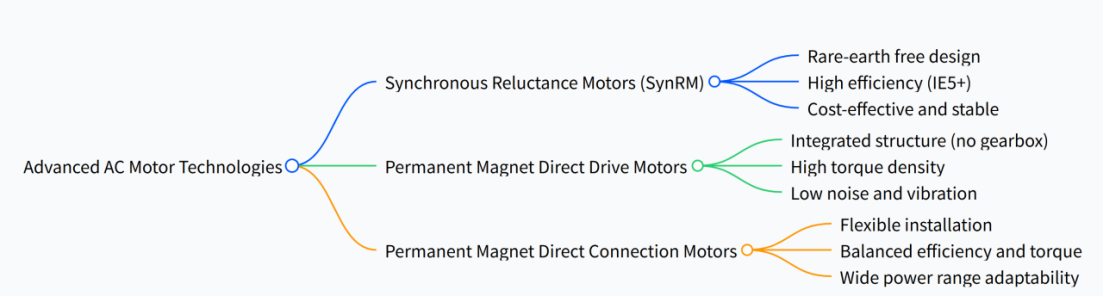
A leading motor manufacturer offers the three technologies above, providing tailored options for industrial users:
• For energy-intensive continuous operations (e.g., 24/7 pump systems in water treatment plants), synchronous reluctance motors are ideal. Their rare-earth free design avoids supply chain risks, while IE5 efficiency delivers long-term energy savings. The motor’s low heat generation also extends maintenance intervals by 30% compared to traditional models.
• For precision automation (e.g., robotic arms in 3C manufacturing), permanent magnet direct drive motors excel. Without a gearbox, they eliminate mechanical backlash, achieving positioning accuracy within 0.01mm. Their fast response speed (≤5ms) ensures seamless integration with automated control systems.
• For heavy-load equipment requiring flexibility (e.g., mixers in chemical plants), permanent magnet direct connection motors strike a balance. They offer high torque for startup loads while maintaining IE4+ efficiency during operation. The direct connection design simplifies installation and reduces space requirements by 25% compared to indirect-drive alternatives.
In a food processing plant, replacing 20 traditional IE2 pumps with synchronous reluctance motors (IE5) resulted in:
• 22% reduction in monthly energy consumption
• 40% decrease in maintenance frequency
• 15dB lower operating noise
In an automotive assembly line, permanent magnet direct drive motors improved production efficiency by 18% due to faster response times and higher positioning accuracy, while reducing energy costs by 25% annually.
• Higher Efficiency Standards: Global regulations are pushing toward mandatory IE4/IE5 standards, with the EU planning to require IE4+ for all industrial motors by 2027.
• Intelligence Integration: Motors equipped with sensors and IoT modules will enable real-time performance monitoring and predictive maintenance, reducing downtime by 20-30%.
• Customization: Motors tailored to specific industrial processes (e.g., high-temperature resistant models for metallurgy) will replace one-size-fits-all solutions.
1. Prioritize efficiency based on operating hours: For equipment running over 4,000 hours annually, invest in IE4/IE5 motors to maximize ROI.
2. Match performance to load requirements: Avoid over-sizing motors—select torque and speed specifications aligned with actual operational needs.
3. Consider total lifecycle cost: Factor in energy savings, maintenance costs, and service life, not just initial purchase price.
4. Choose reputable suppliers offering comprehensive technical support, ensuring seamless integration with existing systems.
AC motors are indispensable to industrial productivity, and their efficiency and performance directly impact a company’s competitiveness and sustainability. As technology advances, synchronous reluctance, permanent magnet direct drive, and permanent magnet direct connection motors have emerged as superior alternatives to traditional models, offering tailored solutions for diverse industrial needs.
By selecting the right motor technology based on application requirements, industries can achieve significant energy savings, improve production efficiency, and reduce environmental impact. In the era of green and intelligent manufacturing, investing in high-performance AC motors is not just a cost-saving measure but a strategic decision for long-term success.

