
Views: 14 Author: Site Editor Publish Time: 2025-12-10 Origin: Site


In industrial production, electric motors are the "main force" driving various equipment, from assembly lines to heavy-duty pumps. Choosing the wrong motor can lead to energy waste, frequent malfunctions, and even production interruptions. This article breaks down the selection process into 6 practical steps, specifically tailored for selecting industrial motors. We will also highlight Huima Technology's industrial motors—designed to meet the needs of a variety of factories.
The first step is to understand the "load"—the task the motor must perform. Industrial loads are heavier than household loads, so choosing the right load can avoid costly mismatches.
Loads fall into 3 main groups, each needing a motor with specific strengths:
Resistance stays the same, no matter how fast the motor runs.
Think of a conveyor belt moving boxes of the same weight—it needs steady twisting force to keep going. Examples: mixers, extruders.
Resistance increases as the motor speeds up.
A fan is a classic example—blowing air faster requires more force to push the moving air. Examples: centrifugal pumps, blowers.
Sudden, short bursts of heavy resistance.
Imagine a crusher breaking large rocks—the motor must handle brief, intense stress without failing.
You don’t need complex math, but these two values are non-negotiable.
The continuous twisting force the motor needs (measured in Newton-meters, Nm). A conveyor carrying 1-ton goods might need 50 Nm.
The stable speed the load requires (in rotations per minute, rpm). A factory fan could run at 1500 rpm; a precision assembly line might need 300 rpm.
Load Type | Must-Have Motor Trait | Industrial Examples |
Constant torque | Steady torque at any speed | Conveyors, mixers |
Variable torque | Torque adjusts with speed; efficient across loads | Pumps, fans |
Shock load | Extra torque reserve; durable build | Crushers, stamping machines |
Industrial sites have very strict space constraints—motors must be compatible with existing equipment or installed in confined spaces. Ignoring this can lead to time-consuming rework.
Stick to IEC standards (for compatibility) with these 3 options.

Motors with a base that bolts to floors or frames.
Ideal for large pumps or compressors.
Motors with a front circular plate that attaches directly to machinery.
Saves space for fans or small conveyors.
Compact flange for small, precision machines (e.g., small mixers).
Use high-power-density motors (like brushless DC motors) that pack performance into a small size.
Heavy-duty induction motors work here—size matters less than durability and cost.
Industrial settings are harsh—heat, dust, or moisture can ruin a motor made for clean workshops.
Steel mills need motors with H-class insulation (handles 180°C). Cold storage requires motors that start reliably below 0°C (avoid plastic parts that crack).
Wastewater plants need waterproof motors (IP67+ rating) and anti-corrosive coatings (like stainless steel).
Cement factories need fully enclosed motors to keep particles out (prevents jamming).
Environment Condition | Motor Requirement | Recommended Motor Type |
High-heat (>100°C) | Heat-resistant insulation | High-temp induction/BLDC motors |
Wet/corrosive | Waterproof + anti-corrosive | Sealed BLDC/induction motors |
Dusty | Fully enclosed casing | Enclosed induction motors |
There are four main types of motors used in industrial applications—durability, efficiency, and reliability take precedence over upfront cost. Huima Motors offers three superior options to meet industrial needs.
Motor Type | Core Benefits | Best Uses |
AC Induction | Durable; low maintenance; cheap for large sizes | Conveyors, pumps (80% of industrial use) |
DC Brushless (BLDC) | Efficient; precise control; compact | Variable-speed pumps, precision lines |
Servo | Ultra-precise positioning | CNC machines, robotic arms |
Huima designs motors for factory challenges, with 3 key options.
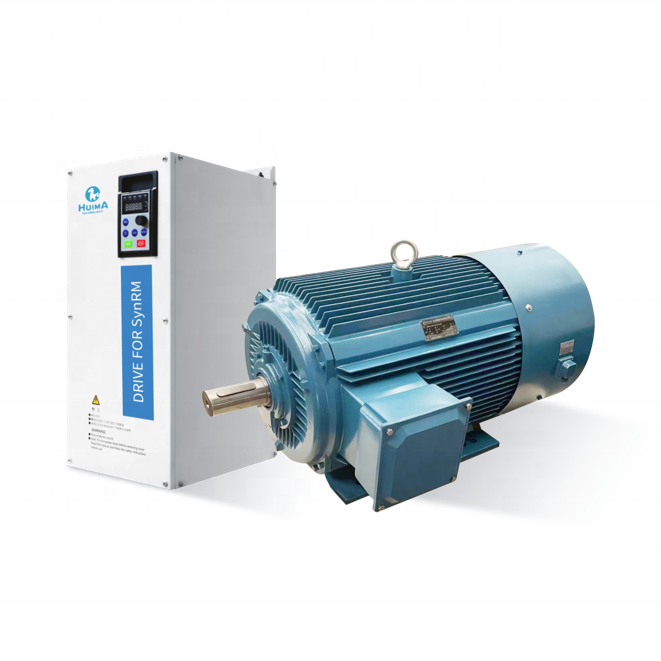
IE5-rated (super-efficient), no rare-earth materials (avoids supply risks), and saves 15–30% energy vs. traditional motors.
Eliminates extra parts (like gearboxes) for less energy loss, quieter operation, and lower maintenance.
Fits directly into existing setups (no reworking) and boosts efficiency for standard machines like fans or pumps.
The motor requires a stable power supply and must work in conjunction with the factory control system (such as a PLC). Incompatibility can lead to damage or malfunction.
Most industrial motors use 3-phase 380V AC (factory standard). Smaller motors use 24V/48V DC. Ensure the motor’s voltage matches your supply (±10% tolerance).
Large motors draw 3–7x their normal current when turning on. Use soft starters or VFDs to protect the power grid.
Variable-load machines (like fans) need VFDs. Huima’s motors are pre-wired for easy VFD pairing.
Motors connect to PLCs for auto start/stop. Huima motors have standard ports—no extra adapters needed.
Built-in overload/short-circuit guards reduce downtime.
Industrial motors are an investment—don’t just pick the cheapest option.
Motors are rated by IE (International Efficiency) levels:
• IE1: <75% efficient (skip for continuous use)
• IE3: 85–95% efficient (mandatory for most industrial uses)
• IE5: >95% efficient (Huima’s top models—saves energy and meets carbon goals)
For a 24/7 pump:
• Old IE2 motor: $800 upfront; $1,500/year energy cost
• Huima IE5 motor: $1,500 upfront; $1,050/year energy cost
Savings with Huima: $450/year. The extra $700 upfront cost is recouped in 1.5 years—plus a 10+ year lifespan (vs. 5–7 years for IE2) means $3,000+ in total savings.

Choosing an industrial motor is actually quite simple: First, determine the load, check the installation dimensions and compatibility, assess the operating environment, select the appropriate motor type, adjust the power and control, and prioritize long-term value. Huima Motors' product range—from ultra-efficient synchronous reluctance motors to low-maintenance direct-drive motors—meets the needs of various factories, saving energy and ensuring smooth production.
The best motor isn't necessarily the cheapest, but rather the one best suited for your work, meets your space requirements, and delivers long-term benefits.

